
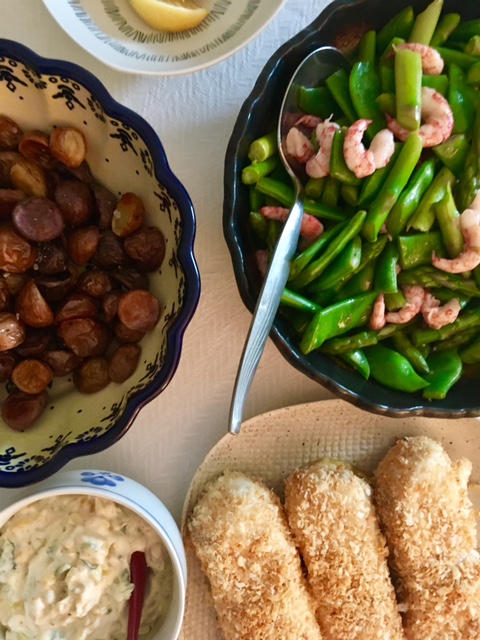
Here’s what I have been cooking at home in August!
Since I am not professionally trained, I always love to learn and draw inspiration from others (professional or home chefs).
This month I am featuring three of my creations which you may have seen the pictures on Instagram already.
For first hand updates follow me on Instagram: @mygoldenapron
And remember, always adjust the seasoning and ingredients according to you and your loved ones dietary needs, and the most important ingredient, COOK with LOTS of LOVE and PATIENCE (OO).
Baked Halibut Filets with Homemade Tartar sauce: (Picture shown above)
I have adapted Just One Cookbook (love her cheesecake and other Japanese recipes) Ms. Namiko Chen’s toasted panko (for baked pork chop/chicken katsu) for my baked halibut filets; I actually skipped the flour and dipped the cleaned and skinned fillets in beaten egg and toasted panko only. Once the panko cooled down, add grated lemon zest (1 lemon), 1 teaspoon of sea salt and mix well, set aside.
Baked Halibut fillets: (ingredients: halibut fish fillet, panko, one lemon (for slices and lemon zest), salt and pepper)Pre-cook the panko before baking the fish fillets: For the 4 fillets, I have used 1 cup of panko and 1 Tablespoon of extra virgin olive oil. Combine the oil and panko in a frying pan, and toast the panko over medium heat, stir once in a while to ensure all panko bits are toasted until golden brown and evenly. Tremendous patience is required for this step. Let the toasted panko cool before you start coating the halibut fillets.
Preheat oven to 400F. Lined the baking sheet with parchment paper. Pre cut some lemon slices (using the same lemon which you used to get the zest) and placed them on the baking sheet.
I bought 4 filets (there were 4 of us) and total weighed approximately 1.5 lbs. Skinned the halibut filets (or you can ask your fish monger to take care of this), pat them dry.
Coat the halibut one at a time: gently dip each piece into the beaten egg mixture, make sure you get rid of excess egg mixture. Using your dry hand, coat the fillet with toasted panko. Lightly brush the flakes to cover the fish, then lightly press the panko flakes, make sure they adhere and the fillet is coated evenly. Place the coated fillet on top of lemon slices on the baking sheet. Baked fish fillets until cooked through (test using a bamboo stick or tooth pick, once it goes through the fillet easily they are done), approximately 12 to 15 minutes. Halfway through I turned the baking sheet around (for even cooking) quickly, and I checked the fillets quickly at the 10 minute mark for doneness.
Serve cooked fillets with homemade tartar sauce: I do not have any specific quantity for this recipe; I used the OJAI lemonaise (or any mayo) and Greek yogurt at 1-1.5 ratio, added some lemon zest, cooked corn niblets and takana (optional – dried radish leaves, rehydrated), sea salt and black pepper (a pinch) to taste. If you want to thin out the sauce a little, you can add a squeeze of lemon juice.
As for my bean, asparagus and prawn salad with ponzu vinaigrette, I used a store-bought ponzu and add good quality extra virgin olive oil, a little rice vinegar and ground pepper for the vinaigrette (2:1 ratio oil/soy, most vinaigrettes 3:1 ratio oil/acid, I prefer less oily). I blanched the asparagus, sautéed the beans and boiled the small prawns (with lemon) quickly, then shocked them in ice and shelled them. When you are ready to eat, toss the ingredients together and lightly dress the salad (do not drench!!).
Note: Be creative with your vegetable selection, and remember always adjust your seasoning according to your dietary needs and taste !
Pork and Yamaimo (Mountain Potato) patties with apple ginger sauce, sautéed cauliflower, enoki mushroom and okra

I still cook a lot of Japanese food at home.
I adapted the patty and sauce recipe from the popular Japanese chef Masa (Masa’s ABC Cooking @masa.abc on Facebook) who resides in Taiwan. If you check his Facebook page, there are regular uploads of cooking videos with wonderful and clear instructions (for readers who can understand Chinese, it is in mandarin, Chinese subtitles on-screen). I love his idea of using yamaimo (mountain potato) with ground meats; the addition keeps the patties very moist! Chef Masa’s original is actually a chicken patty donburi recipe (with okra and eggplant), I created a dinner set and served with cauliflower, enoki mushroom and a dairy free chilled potato leek and watercress soup.
Pork Patties: organic /hormone free ground pork 250 g, 1/4 of yamaimo (mountain potato, grated), grated ginger, 1/2 teaspoon sea salt, 1 egg, 1 stalk green onion (chopped), grated ginger (1 teaspoons), 1 Tablespoon tamari****, 1 teaspoon maple syrup***, pinch of white pepper for season, 1 Tablespoon extra virgin olive oil ***tamari and maple syrup are my choices, I prefer also not to use too much oil. The original recipe
Thank you Chef Masa for such a great recipe and inspiration!
Using your clean or spatula, mix ground pork and sea salt until you achieve a “smooth and sticky” texture. Then add the egg, chopped green onion, grated ginger, maple syrup (or sugar), tamari and grated yamaimo to the meat, use the spatula in a “cutting” motion (easier to work with the mountain potato), fold and blend well. Set aside.
Apple dipping sauce: Add Tamari, mirin and sake (1-1-1), 1/4 apple, 1 clove of garlic, 1 teaspoon maple syrup and 1 small knob of ginger to blender, puree and blend. Taste and adjust your seasoning (I tend to use less soy). ***When using maple syrup you may need a little more to cut down the sharpness of the ginger.
As for the vegetables, basically anything goes. I just sautéed and lightly season them with sea salt, cover up with aluminium (another great tip from Chef Masa) to keep them warm.
Using medium heat, heat frying pan and add the extra virgin olive oil, using a Tablespoon (or small scoop), spoon the meat mixture onto the frying pan, forming small “pancake” size patties (you can always adjust). Do not crowd the pan with too many patties at once, medium size pan should fit 3 to 4 small size patties. Let it cook for a few minutes before gently “lifting” the patty to check if it is set, once they turn golden brown, it is time to flip the patties and let them cook through. When patties are almost cooked, spoon some sauce over the patties and let the flavor melt together. (**With pork it is better to cook a little longer, the yamaimo actually keeps the patties moist). I heated the remaining sauce and served it on the side.
For the original recipe and video, please check his site on Facebook or English website.
https://www.facebook.com/masa.abc/
Homemade Heirloom Tomato and Kabocha Fish Soup with Rice Noodles and vegetables

Recently I am on a “chinese food mode” and I decided to make my own “Fish soup rice noodle at home”.
I go through phases from time to time; recently I have been watching a lot of Chinese cooking shows.
I must admit as I am getting older, and having lived overseas for such a long time, I have a stronger desire to get back to my “roots”.
Soup Base: 2 small size yellow croaker fish (cleaned – or any white whole fish which is great for soup making, don’t splurge on anything too expensive), 1 medium size kabocha (Japanese pumpkin seeds removed and chopped into pieces), 2 big heirloom tomatoes and 3 medium tomatoes on the vine (seeds removed and loosely chopped), 9 cups of cold filtered water, 2 croaker fish (cleaned), knob of ginger, green onion, cilantro, 1 large yellow onion, 2 to 3 stalks of celery (optional), a small knob of ginger (sliced), sea salt and white pepper for seasoning.
**This is a pretty large pot of soup, we had some for dinner the other night and used the rest for noodles. This can feed a family of 4 to 6 easily.
I actually made the soup two days ahead of time; here is a good tip for preparing the kabocha: I admit I am not strong enough to “chop” through the kabocha and honestly I don’t want to lose my hands along the way, my friend Sofei told me to put the kabocha into a pot of hot water and let it slowly simmer for a while The skin will soften and make it much easier to cut through. Once it is ready, peel the skin (I use a peeler), scoop out the seeds and chop into 1 inch pieces. Seed the tomatoes, loosely chop cilantro, celery stalks, onion and green onion (keep stalks in tact). Set aside.
Clean the fish (remove the blood line), pat dry, lightly seasoned with sea salt and white pepper Heat the frying pan over medium heat, add a little extra virgin olive oil, add and stir fry th ginger slices. Add fish to frying pan, and cooked both sides until slightly golden brown. You can always add a splash of Chinese cooking wine (Shaoxing) to eliminate the “fishy” taste, I find by using ginger and definitely be mindful about removing the bloodline (at the neck between the head and body, you can see a little “clot”), the fish is not bitter or “fishy” at all.
Fill large clay pot with cold filtered water, add tomatoes, onions and celery.
Remove the fish from frying pan and together with the ginger slices, put inside the “fish soup bag” (can be purchased at most Asian supermarkets). Tie a tight knot. Add the fish bag to the soup pot.
Bring it to a boil, skim the “scum” and turn down to medium low heat, let is slowly simmer for 1.5 hours. While the soup is simmering, check and skim the foam from time to time.
Using chopsticks or tongs, remove the celery stalks and the fish bag. Using a spatula or ladle, “squeeze” the fish bag gently , you will find a lot of soup is actually “soaked” into the bag, you don’t want to waste the liquid gold!
Add half of the kabocha chunks into the soup, and let it simmer for another half hour to 45 minutes, let the flavors melt together (I like my kabocha “melted”. Finally add the remaining kabocha chunks, cilantro and napa cabbage, simmer until vegetables are cooked through. Season with sea salt and ready to serve as soup in a regular Chinese family dinner.
To turn this into a noodle soup base:
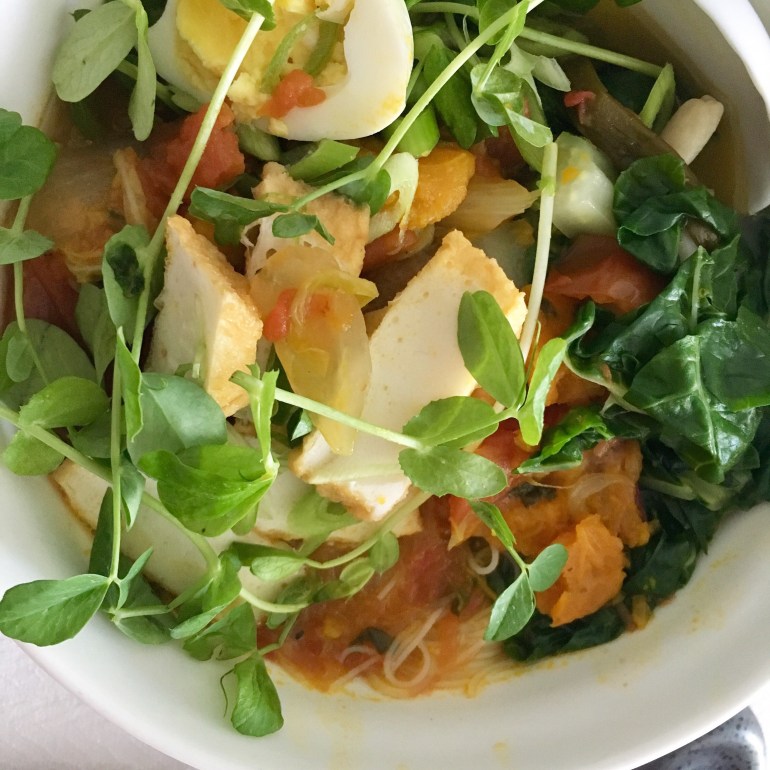
Noodle and Fixings (be creative): rice noodle, mung bean noodle, shimeji mushroom, napa cabbage, bok choy, swiss chard, microgreens (for garnish), tofu fish cake, green onion, boiled egg. I am not going to list the quantity because it really depends on how many people you are feeding.
Cook all vegetables and fixings separately (all boiled) and create a noodle bar, lay out all ingredients, and chopped up more cilantro and green onions for garnish.
Have fun and be creative with your dinners…now as my friend Peter (Pastaboypeter on Instagram) always say, “now go and eat with the ones you love”.
Sources for my ingredients in Vancouver: Seafood City (Granville Island), Vancouver Farmers Market, Choices Market, the August Market, Sakuraya Japanese food store, T & T Supermarket and H-Mart.

 My Golden Apron