RRRRRR…It’s only mid-November yet it feels like we are already “deep” into the winter season; it might be chilly but I am not complaining as we have enjoyed some fine sunny days, which is quite unusual here in Vancouver…
So out come the Dutch oven and my Blender as Hearty Soup season is in full swing!
We don’t have kabocha very often in our household as it is not Andy’s favorite, I cooked it only once in a while for my own enjoyment, prepared either in Japanese (simmered in dashi and soy) or Chinese way (stewed with pork and soy).
I was so inspired by my friend Haruko’s creation; she made the most delicious and elegant version by keeping things simple, using fresh in-season ingredients (kabocha, onion, homemade chicken stock, milk) and let them shine; I feel this is always the best way to cook.
I decided to incorporate my favourite “Wafu” style (yes again) into this recipe; the idea of the toasted nori came from Canadian food blogger “The First Mess”; she adapted the kabocha + chestnut soup recipe from Amy Chaplin’s cookbook ” At Home In the Whole Food Kitchen”, this cookbook is on my Christmas wishlist…any takers?? (OO)
Ingredients: (serves 2 – 4)
1 medium size kabocha, seeded, peeled, chopped into small cubes, 1 large yellow onion (thinly sliced), 2 garlic cloves (thinly sliced), 1 Tablespoon sake kasu (optional), 2 Tablespoon olive oil, 3 1/2 cups Japanese dashi broth*, 1 to 1 1/2 cups regular almond milk, 2 teaspoons Japanese mirin, 1-2 Tablespoons organic soy sauce, sea salt and freshly ground pepper for seasoning to taste, nori seaweed (**optional, toasted for garnish).
Preparation:
– Prepare the kabocha squash: sliced it open into two halves. Remove the seeds, then cut into thin wedges; remove the skin then cut them into small even pieces
– Prepare the onion: peel and slice thinly
– In a 4 quart pot reheat the dashi broth, bring to a boil, lower heat and keep it simmering (if you are using pre-packaged dashi powder, prepare the stock according to instructions on package)
– Using a different heavy pot, heat the olive oil using medium high heat. Add the onions and saute until they become soft and golden (6-8 minutes), add the sliced garlic and saute until it becomes fragrant.
– Add the kabocha to the same pot, add 1 teaspoon mirin and gently mix all ingredients; add reheated dashi broth, 1 Tablespoon of sake kasu and bring mixture to a boil. Once boiling, lower the heat (medium low) and simmer until kabocha is tender (you can use a fork to test the texture), approximately 20 minutes. Using a slotted spoon, skim off any scums.
– While soup is simmering, prepare the nori – remove from package, lightly brush them with olive oil/mirin (1:1 ratio) mixture. Using medium low heat, place seaweed on small fry pan and toast them lightly using dry heat. The seaweed should be toasted on both sides, be very careful not to overheat and burn them. Set aside.
– Using an upright blender, working in small batches, process and puree the soup until smooth (be mindful to fill blender jar less than half way). To prevent the liquid from splattering, remember to allow heat to escape by removing the blender’s lid centre insert (cap), hold a kitchen towel over the top when blending.
– Return puree soup to stock pot, over low heat, stir in the almond milk slowly till mixture is combined, do not let the soup boil.
– Season with sea salt and pepper to taste.
– To serve: ladle soup in bowls and garnish with toasted nori.
*Notes:
Dashi is a fundamental ingredient to many Japanese dishes; it is used in miso soups, noodle soup, stews (oden) and sauces.
For your convenience, you can purchase the instant bonito stock packages which are readily available at Japanese food stores, and follow the instructions.
I choose to make my own awase dashi (basic stock) on a regular basis as I used it quite often as a substitute in many recipes. It is a combination of kombu (kelp) and katsuobushi (bonito flakes) and I have been using the recipe from Practical Japanese Cooking (by Shizuo Tsuji and Koichiro Hata) ; you can also find recipes available online.
You can substitute dashi broth with either vegetable stock or kombu stock (without the bonito flakes) to make the soup a completely vegetarian dish, or use chicken stock.
Sake kasu is optional, it adds lots of flavour to soups and stocks. In Vancouver you can purchase at Fujiya Japanese Food Store or Artisan Sake Maker (Osake) in Granville Island.
Always taste and change the ingredients according to your liking and dietary needs.
The pie I made for Thanksgiving Dinner – this picture was selected and made it to this week’s Vancouver Sun Gastropost.
My sister-in-law Marcia is a pescatarian/vegetarian and a serious dessert/chocolate connoisseur; for almost every Festive family dinner gatherings when a “meat” dish is usually the main event, our mother-in-law would happily make our family’s favourite “Not real sushi – California rolls” (recipe already posted) or baked a salmon fillet for her, changing the sauce (Teriyaki, beurre blanc) each time. Although she enjoyed them always, it became a routine…
I decided to change things up just a bit after revisiting the classic recipe: I know it’s not major or “life defining” culinary moment, the thought process behind the thinner crispy potato crust (instead of usual mashed potatoes) was very simple; the “pie’ idea was inspired by Marcia’s past lovely desserts and believe my entire extended family will find this more enjoyable, it’s less carbs (haha) and less fat (from the sauce to the filling). Over time, I find myself putting even more consideration and thought into the food which I cooked for family and friends, a lot of times it is for health reasons and their preference; this is my way to express my love to those close and dear to me.
This dish, along with the juiciest turkey I’ve ever cooked together with my mother-in-law, and the sides and salads (Thanks Barb and Gina) and desserts (thanks Marcia! The chocolate truffle cake and apple galette were divine) prepared by my sisters-in-law were devoured in no time.
That was another happy busy day in the kitchen, happy meal, happy gathering, happy family moment together…I have so much to be thankful for.
On another happy note: I submitted the “pie” picture to Vancouver Gastropost for last week’s “Pie Oh My” Mission, it was selected and featured in Saturday’s weekend paper! Thank you Vancouver Sun for the acknowledgement (OO).
Ingredients: (For 9 1/2 inch pie plate)
500 g wild sockeye salmon fillet, 2 leeks (white part only, finely sliced), 4 to 6 Yukon gold potatoes (peeled and grated into strips), Japanese panko (handful), fresh juice of 1 lemon, 1 Tablespoon fresh dill (chopped), 1-2 Tablespoon grapeseed oil, sea salt and white pepper (for seasoning), grated cheddar (as you like and it is optional)
For Lemon dill infused bechamel: 4 cups of “tempered” unsweetened almond milk, 3 to 4 sprigs of fresh dill, peel of 1 lemon (strips), 1 bay leaf, 1/4 teaspoon kosher or sea salt (or to taste), 1/4 cup (approximately) of all-purpose flour, 3 to 4 Tablespoon grapeseed oil (traditional roux calls for butter, fat and flour is usually 1-1 ratio, I’ve used less than 3 Tablespoon of grapeseed oil). **Using grapeseed oil and unsweetened almond milk is my personal choice.
Preparation:
One Day Ahead: Prepare Lemon dill infused Bechamel Sauce
– In 4 quart Sauce pan, start “tempering” and flavouring of almond milk: (this is an important step as cold milk will result in lumpy and grainy sauce)
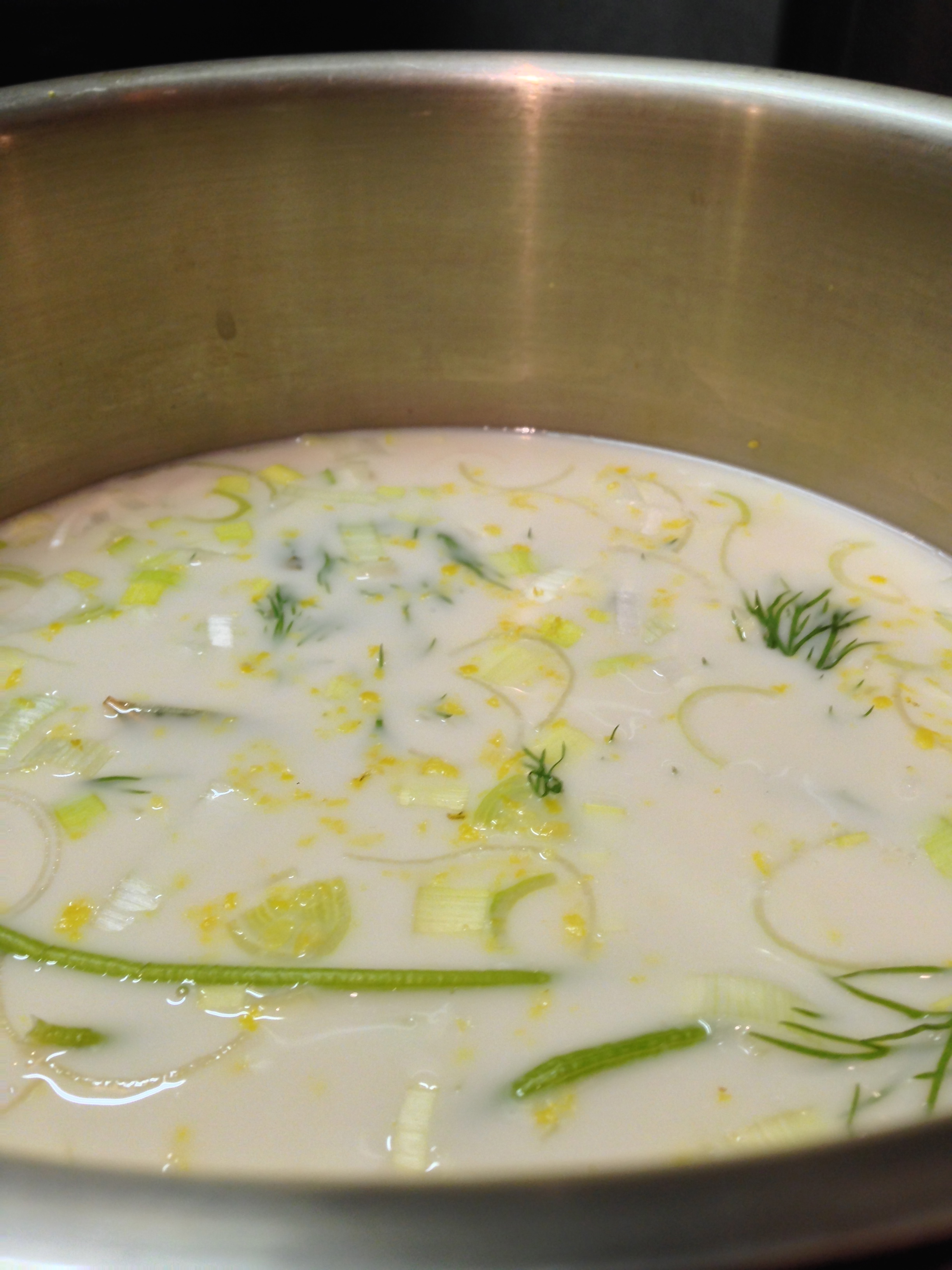
– Rinse saucepan with cold water (do not wipe dry – this will prevent the fats and protein from scorching the bottom of the saucepan), add unsweetened almond milk, then the aromatics – sprigs of fresh dill, lemon peel, bay leaf.
Flavours are steeping and simmering away!
– Using medium low heat, bring liquid to a simmer (Do not bring to a boil), turn off the heat, cover with lid and let the flavours steep for at least 15 minutes (I did for 20 minutes).
– The hot milk should now be ready; it can now be strained into a measuring cup. Discard all flavouring ingredients.
– Wipe the saucepan clean, over medium low heat, start making the white roux (combining fat and starch together): add olive oil to saucepan, when oil begins to bubble, begin adding flour, keep stirring to form a smooth thin paste. The flour should be incorporated into the olive oil fully, continue to cook the roux by stirring constantly over medium low heat in order to prevent scorching (burning), the process should be no longer than 2 minutes (white roux does not take on colour), you are looking for a smooth and thin consistency (not thick and lumpy).
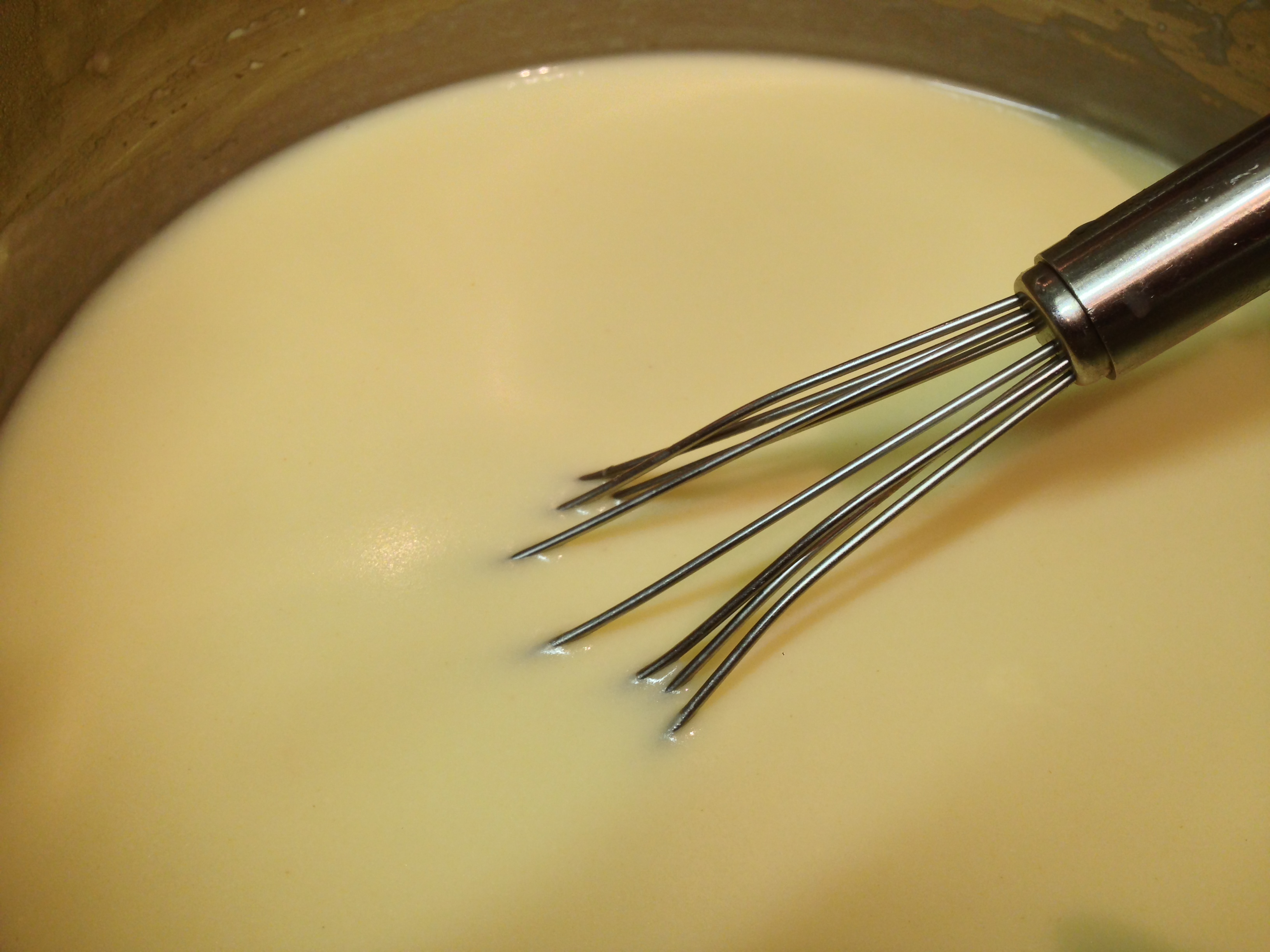
– Once the roux is ready, add hot milk to hot roux a bit a time while constantly whisking (easy to use a flat whisk) or stirring (spatula), let the mixture come back to a simmer each time before adding more hot milk. Once all the milk has been added, bring it to a gentle simmer while stirring. Lower The heat and simmer gently for 10 to 15 minutes, pot uncovered (important), in order to cook out the starch flavour. Be careful not to bring to a boil as sauce will burn or split. Using a whisk, stir occasionally, make sure you scrape the bottom edges of the pot. The sauce should coat the back of a spoon nicely, once it finishes cooking, turn off heat, season to taste with sea salt and white pepper (optional). Strain the sauce into one more time for a silky smooth texture.
Whisking Away!
– To store properly, pour sauce into a glass bowl and place a plastic wrap over the hot bechamel, when cooled completely, refrigerate. The sauce will thicken considerably; to reheat the next day, add a little water (or stock) to the cold bechamel, stir and bring to a simmer.
Preparation on The Day Of:
– Pre heat oven to 350 degrees F (to bake the salmon).
– Clean and pat dry salmon fillet with paper towel, using tweezers (I keep one for cooking) remove pin bones.
– Place salmon fillet (skin side down) in baking tray. Mix 1 Tablespoon grapeseed oil and lemon juice in a small bowl, and drizzle over the salmon. Season by evenly with chopped dill, sea salt and fresh ground pepper (optional) to taste. Bake approximately 20 to 25 minutes in the preheated oven, or until salmon is easily flaked with a fork; the salmon should still be pinkish and moist.
– While salmon is baking, peel and grate (or using a knife to slice) the potatoes into thin strips, place in a sieve, add 1 teaspoon of salt. Squeeze out as much liquid as you can with your hands; leave to drain for 10 to 15 minutes. Repeat the process again with another teaspoon of salt, leave for another 10 minutes and again squeeze hard to remove as much moisture as possible. Pat dry with paper towel, cover and set aside.
– Once salmon is cooled considerably (don’t burn yourself!), start “flaking” the salmon by using a fork, the flakes should come off the skin easily. Flake them in “bite-size” (not large chunks), do not include salmon skin, make sure all bones have been removed. Set aside
– In saucepan reheat the bechamel sauce by adding a little water to the cold sauce, stir and bring to a simmer. Turn off the heat when ready.
– In separate 6 quart pot, add drizzle of grapeseed oil over medium heat. Add the leek and cook, stirring often, for 4 to 5 minutes, or until soft but not browned, then add salmon flakes. Turn off and remove from heat, using a spatula, slowly and gently “fold in” bechamel sauce (a few spoonfuls at a time) with salmon mixture. the filling should not appear runny (Do not stir)
– Pre heat oven to 375 degrees F.
– Mix the grated potato strips with a handful of Japanese panko. Lightly brush the bottom of the 9 1/2 inch pie plate (mine is my Mom’s “vintage” Pyrex) with grapeseed oil, then sprinkle with chopped dill. Then pour the salmon filling, and top with the grated potatoes in an even layer, lightly brush the potatoes with just a little grapeseed oil, the crust should brown nicely.
Depend on your liking, you can put more potatoes. Remember to layer them evenly!
– Place on a baking tray in the oven and cook for 40 to 45 minutes, or until heated through and bubbling, the potato crust should be golden brown and crispy. Serve immediately.
Notes:
– Bechamel sauceand salmon flakes can be made one day ahead; just remember to let all prepared foods cooled down, store in proper containers before refrigerate.
I actually prepared this salmon flakes and the bechamel the day before our family’s Thanksgiving gathering; it’s all about “mise en place” – getting organized and give yourself some breathing room on the day of!
If you choose to make the bechamel sauce at the same time, prepare it while the salmon is baking in the oven. Have to work pretty quickly!
– Bechamel sauce, also known as white sauce, is made from roux (butter/flour) and milk. It is a “mother sauce” in French and Italian cuisines, and used as a base for other sauces (for example French Mornay sauce – add cheese to bechamel), so it’s handy to learn how to make the base properly. The choice of herbs to flavour the milk can be changed according to recipe.
The bechamel sauce cooking method is something I’ve learnt through the online cooking school Rouxbe; I am a life-time registered student/member for amateur programs. Their instructional videos are very informative, the instructions I’ve written are based on the narration. For serious home cooks, it may be worthwhile to register (http://rouxbe.com/); they also have professional programs available.
– Be mindful with the seasoning as salt is used to season all ingredients separately (especially the potatoes, salt was needed to “draw” the water), you don’t want to end up with a very salty pie!
– Always adjust all seasoning according to your taste and dietary needs.
– As I’m only a home cook, I’ve tried my best to record the measurements while I was preparing this dish, please feel free to adjust if necessary.
– Adding cheese (grated cheddar) is optional as it makes the dish “heavier”: I did when I made this pie (see main picture) for Thanksgiving dinner, I skipped when I made our smaller home pot-pies for dinner, which I served with peas for dinner. Enjoy (OO)!
I’ve cooked many different types of stews in the past and this is only the second time I’ve prepared the Vietnamese Tomato Beef Stew (Bo Kho), my nephew’s favourite and he has always enjoyed this dish at another of our local favourite eateries in Vancouver, Au Petit Cafe (at Main Street and E. 32nd Avenue). I am so happy that I actually prepared this dish for my family; a big thank you to nom nom paleo for her wonderful wonderful recipe, I’ve used it as a base, made some changes and incorporated my own cooking methods. Beef stews are always more flavourful when prepared ahead of time, it’s best to start the preparation two days ahead for this dish (OO).
Ingredients:
2 1/2 pounds of boneless short rib (trimmed and chopped into 1 1/2 inch chunks, pasture fed beef if possible), 2 large lemongrass stalk (bruised and chopped into 1 to 1 1/2 inch length), 3 Tablespoons fish sauce, 1 1/2 Tablespoon Madras Curry powder, 1/2 Tablespoon Five Spice powder, 3 Tablespoons peeled and finely grated ginger, 4 Tablespoons applesauce, 1 bay leaf, 1 Tablespoon organic butter and 2 Tablespoon grape seed oil, 1 finely chopped yellow onion, 2 cups diced fresh tomatoes (peeled, seeded and crushed), 3 cups organic beef broth (or homemade pasture beef stock), 1 pound carrots (cut into one inch slices), kosher salt, cane sugar (finely grated), 1/2 cup chopped cilantro, store-bought French baguette
Preparation:
– Two days ahead: Toss boneless short rib chunk, lemongrass, fish sauce, curry powder, five spice powder, ginger, bay leaf and 2 Tablespoons of applesauce in mixing bowl, mix everything well, sealed and marinade overnight in refrigerator.
– One day ahead: Let marinade beef mixture cool to room temperature; in Large Dutch Oven heat grape seed oil, using medium high heat, seared the short rib chunks in batches until they are browned all over. Place the seared beef aside; Reserve the lemongrass stalk and bay leaf from marinade.
– In the same Dutch Oven, using medium low heat, add butter and saute the chopped onions until they soften; add the crushed tomatoes and kosher salt to taste, stirred to combine. Simmer the mixture (approximately 15 minutes) until a thickened paste is formed.
– Add short rib chunks, lemongrass stalk and bay leaf to “thickened” paste, stir and mix everything well.
– Add beef stock and remaining applesauce to Dutch oven and bring mixture to a boil; lower heat to medium low and let stew simmer for approximately two hours or until short rib is really tender.
– Remove from heat; transfer beef/lemon grass to another large bowl, then strain the sauce in order to remove all residue
– Quickly clean the Dutch oven, return all ingredients and sauce, and add the carrots; simmer in medium low heat for approximately 30 to 45 minutes until carrots are softened. Season with fish sauce and cane sugar to taste. If you think the sauce is a little thick, add more water to dilute the mixture and adjust the seasoning with fish sauce and grated cane sugar.
– When stew has cooled down, skim any visible oil and refrigerate overnight.
– Serving on the day: Skimmed all the fat (if any) and reheat the stew in low heat and bring it to a simmer.
e- To serve: Top the stew with freshly chopped cilantro and serve with oven toasted French baguette!
“Phnom Penh” is one of our favourite Vancouver eateries; my friend “PPQ” came up with this “lazy” version (without soup) and recently I have fine tuned this easy recipe. The ingredients are simple and easy to prepare, it is also fun to prepare this for a “buffet” or potluck party, all you have to do is prepare the toppings and everyone can assemble their own noodle dish and spark an interesting dinner conversation! Enjoy (OO).
Ingredients: (Serves 2 – 4 as light meal/appetizer)
1 package of fresh Chinese rice noodle “Cheong Fun” roll (650g, with scallions and dried shrimp) (available at most Asian supermarkets), Tiger prawns (approximately 3-4 each person for each serving, shelled, deveined, boiled), lean pasture raised ground pork (250g), fish sauce (for seasoning the pork), cilantro, fresh lime, 1 package of bean sprouts, green scallions (chopped), fried garlic and fried onion (you can make your own or purchase prepackaged product from Thailand), fresh Thai chilies (seeded and finely chopped, optional), Chinese “Tianjin” preserved cabbage (small handful)
For the sauce: Indonesian Sweet Soy Sauce, low sodium chicken stock, dark soy sauce (1-1-1 ratio)
Other condiments: Store bought Sambal Olek Chilli Sauce, chopped Thai chillies mixed with white vinegar (optional), Homemade prawn oil (optional)
Preparation:
– Cut the rice roll into bite size (approximately 1 inch lengthwise); then slice through the middle to make them thinner; sprinkle with cold water and reheat in rice cooker (leave them in rice cooker under “keep warm” mode”).
– To prepare the sauce: mix all ingredients and bring to boil, adjust sweetness and saltiness according to your liking
– Instead of oil, add a little water to skillet and saute the ground pork in high heat, add a little fish sauce for seasoning, set aside
– To prepare the prawns: shelled and deveined (with tail intact), add water to medium size pot (enough to cover the prawns), add a slice of lemon and a few black peppercorn and bring liquid to a boil; add prawns and cook until just opaque throughout. Have an “ice” bath ready; when prawns are cooked, pour the prawns into strainer and “shock” in ice bath immediately to stop the cooking process. Strained and set aside.
– Parboil the bean sprouts quickly, strain and set aside.
– Prepare the preserved cabbage – soaked in cold water for at least 15 to 20 minutes, squeezed dry and chopped finely; chop green scallions, cilantro, slice the limes.
– To serve, Place each ingredient in individual serving bowls, prepare a condiment tray and set up the self-serve noodle bar. Enjoy!
Notes:
You can adjust the meat/vegetable quantity and taste according to your taste and dietary needs. Steamed pork belly slices are also good addition to this dish.
Indonesian Sweet Soy Sauce – the brand which I’ve used is called “ABC”, it’s available at T & T Supermarket. When making the sauce, I diluted the sweet soy sauce with low sodium chicken broth to lessen the sweetness.
I used the prawn shells and prepared my own oil (It’s simple and easy to prepare).
We love Japanese “yoshoku” (Japanese style western food); there is always an abundance of Japanese ingredients in my pantry. This style of cuisine is very popular in Vancouver and there are few restaurants which serve this style of dishes. It is also very easy to find the ingredients to make our own version at home. More than a week ago I was discussing this topic with my twin “Green Apron”, I decided to make my own version and added my own twist, Baked Spaghetti Squash. Mushrooms and Squash are in season now; with this version we can enjoy more vegetables and feel just as satiated. This is a homemade and light recipe, all measurements are approximate; always adjust according to your own taste and dietary concerns.
Ingredients (serves 2 – 4)
1 medium spaghetti squash (yields approx. 2 cups), 150 g pasta (1 cup cooked – spaghettini or angel hair), 2 strips of bacon (small bite size, I used organic), 3 cloves of garlic (minced), 1 small onion (thinly sliced), 2 packages of shimeji mushrooms (I used organic bunashimeji, approximately 300 grams), 2 teaspoons olive oil, 1 1/2 Tablespoons Dashi Soy Sauce, 1 1/2 Tablespoons Japanese Soy Sauce (I used low sodium organic), sake (one teaspoon), salt, shichimi togarashi**optional (Japanese seven flavoured chili powder) and/or black pepper **optional to taste, bonito flakes (katsuoboshi, handful), seaweed strips (handful)
Preparation:
– Pre-heat the oven to 375 degrees (F)
Almost ready to scrape and scoop!
– Clean spaghetti squash and cut it in half (sharp knife required and be careful!), remove the seeds; place squash on baking sheet (lined with foil), cut side down. Pre-cut squash cooks faster, baked until it’s done takes approximately 35 minutes. Let the squash cool about 10 minutes then using a fork, scrape the sides of the squash lengthwise, scoop them out and place them in a bowl, set aside. Handle with care as they are fragile.
– For shimeji mushrooms, slice about 1/2 inch off the cluster (discard) and separate them.
– Cook pasta in salted water (do not over salt) according to instructions, or until al dente
– Using deep skillet, Add 1 teaspoon of olive oil and lightly saute the bacon (for this recipe, the bacon is not crispy), remove bacon from pan and set aside;
– Using the same pan (with bacon oil and adjust the heat to high, add remaining olive oil, then onions, stirring occasionally and cook until lightly browned
– Add mushrooms, garlic and sake (just a splash), cook for approximately 2 to 3 minutes (you can hear the squeaky sound but no liquid release, fully cook mushrooms without browning), return bacon to pan, add half the dashi soy, season with black pepper (lightly).
– Lower the flame to medium, add cooked pasta to mixture, using tongs, toss well for a minute or two ; then gently incorporate the spaghetti squash, add remaining dashi soy and soy sauce, mix well. Season with more soy sauce (if necessary to taste, black pepper and/or shichimi (optional).
– To serve, garnish with seaweed and bonito flakes. Enjoy!
Notes:
– Most of the Japanese ingredients can now be purchased at supermarkets or your local Japanese food stores (Vancouverites can visit Fujiya on Clark in East Vancouver or Izumi-ya on Alderbridge Way in Richmond). Here in Vancouver Dashi Soy is only available at Japanese food stores. For a healthier version and if you have time, you can prepare your own dashi soy; some other home cooks use tsuyu(Japanese noodle dipping sauce) as substitute. To make it entirely vegetarian, skip the bacon.
– Instead of olive oil, using butter will add more flavour and round off the dish very nicely as it goes well with shimeji mushrooms.
– To keep it “wafu” style, you can omit the “heat” (no black pepper/shichimi), it’s a personal choice.
– Using the spaghetti squash is my own preference; at Cafe de L’Orangerie (1320 West 73rd Avenue, Vancouver), they add Japanese cabbage and use more pasta. Do not over bake the squash as it gets mushy; I have yet to master the cooking time and scooping technique to get long strands (OO)
– There are many varieties of Japanese style spaghetti; you can find more recipes on Cookpad and elsewhere on the Internet, there are cooking demos on Youtube.
Riley Park – LIttle Mountain, particularly along Main Street, between East 16th to 33rd Avenue, is one of my favourite neighbourhoods in Vancouver; I swear I must have walked by Trilussa Pizza and Pane (http://trilussa.ca/) many times. For reasons unbeknownst to me, I always assumed it was only a coffee house! It was not until recently when my “twin” brought me to this wonderful unassuming little #pizza and #pane eatery, I realized how much I’ve missed since the summer of 2011! Pardon my ignorance, I recently looked it up on #Urbanspoon and realize they have a 97% approval rating from the community and received rave reviews from many fellow food bloggers.
The three of us ordered three different types of specialty pizzas (other than classics like Margherita) which they sell by the slice (squares or rectangles, in various sizes) or as a whole: the Vancouver (Smoked salmon, organic salad), Caprese (tomato/bocconcini/organic salad) >and the Attillo (mushrooms and mozzarella, picture not shown), served on a wooden paddle. They keep things authentic and simple: thin and crispy crust, fresh produce, nice cheeses, cured meats and olive oil. In every bite you can taste the flavours, every ingredient shines through.
Caprese – Tomato, organic salad and bocconcini (small mozzarella cheese)
Besides pizzas, they also offer panini, soups, and of course, coffee. It is a fairly small place with not much seating, however the three times I’ve been there since late summer, somehow we always managed to find seating on a Saturday afternoon. Staff are very friendly; I can tell they are highly supported by their neighbourhood! Everyone seems to know them very well, while dropping by for a bite, they also stop by to chit chat.
Little Mountain is a wonderful community filled with many hidden gems; whether you are an out of town visitor or a local, it is definitely worth your while to pay a visit.
Information:
#Trilussa (4363 Main Street, Vancouver, BC (Between East 27th and East 28th Avenue)
Fresh pizzas made with freshest ingredients, friendly service, reasonable prices and moderate portion sizes. Seating is limited. Menu and pricing available on-line (http://trilussa.ca/)
Street parking is available (mostly metered, if you live in the neighbourhood, walking is the best way to get there)







 My Golden Apron